To open a med spa, there are several steps you need to take before you start acquiring capital, hiring, or marketing. You’ll want to ensure that you have the right business model in place, the correct licenses, and the workflows you need to maintain consistency and compliance. Here’s what you should consider as you create a business plan and take the steps to opening a med spa.
Key takeaways
- When it comes to determining ownership of your med spa, requirements depend on the state, services, entity, and licenses of the people providing care.
- Ensure that you have resolved ownership, scope of practice, delegation, and medical oversight before signing a long lease or purchasing expensive devices.
- Business ownership and clinical authority are separate questions. Physicians, NPs, PAs, RNs, estheticians, and investors must confirm the structure permitted for their state and proposed services.
- Startup costs depend on your service menu, location, staffing, equipment, and cash reserve. Treat published ranges as third-party planning estimates, then replace them with written local quotes.
- A medical director must provide the level of clinical governance that matches your clinic’s services. A name on a contract is not an operating system.
- In aesthetics, a “Good Faith Exam” often means a pre-treatment medical evaluation. Under the federal No Surprises Act, a Good Faith Estimate is a cost estimate. They are different obligations.
- The most defensible launch plan connects legal structure, patient evaluation, protocols, staff competence, emergency readiness, records, privacy, and continuous quality review.
Table of Contents
Table of contents
- Key takeaways
- What is a med spa, and which services count as medical?
- Who can own a med spa?
- Med spa laws by state: five examples
- Which med spa business model should you choose?
- What licenses and permits do you need to open a med spa?
- Does a med spa need a medical director or collaborating physician?
- What patient evaluation is required before treatment?
- How should you hire and credential med spa staff?
- What clinical systems must be ready before opening?
- What space and equipment does a med spa need?
- How much does it cost to open a med spa?
- How to write a med spa business plan
- What insurance does a med spa need?
- What technology does a med spa need?
- How should a med spa market its services?
- How long does it take to open a med spa?
- How to open a med spa launch checklist
- Common med spa startup mistakes
- How GuardianMD supports med spa operators
- Frequently asked questions about opening a med spa
- Final word
- Sources and further reading
What is a med spa, and which services count as medical?
A med spa is a unique business because it combines the consumer experience of aesthetics services with medical services. That mix creates opportunity, but it also creates legal, clinical, and operational obligations that don’t exist in an ordinary salon. The safest launch sequence is to map the service line first, then build the business around what those services require.
To be a med spa means you’re offering one or more services regulated as medical care. Medical services are defined by state law, the procedure, the product or device, the depth or effect of treatment, and who evaluates and treats the patient.
For example, the Medical Board of California describes medical spas as marketing vehicles for medical procedures. Texas licensing guidance likewise instructs operators to match each regulated service with the appropriate license, training, or physician delegation.
| Service category | Examples | Questions to confirm before launch |
|---|---|---|
| Prescription injectables | Botulinum toxin; prescription medications | Who evaluates, diagnoses, orders, administers, stores, and documents? |
| Implantable devices | Dermal fillers | Who may inject; what consent, rescue supplies, and adverse-event pathway are required? |
| Energy-based procedures | Laser, IPL, radiofrequency, ultrasound | Is the device regulated; is a facility, operator, or radiation-control registration required? |
| Skin procedures | Chemical peels; microneedling; resurfacing | At what depth or intended effect does the service become medical in this state? |
| Wellness add-ons | IV hydration; injections; weight management | What prescribing, pharmacy, lab, collaboration, and monitoring rules apply? |
| Nonmedical aesthetics | Some facials; superficial services | Does the state cosmetology or esthetics board regulate the service and practitioner? |
To outline your medical services, start with a service-by-service regulatory map. Don’t assume that a training certificate expands a professional license or that a device vendor’s course authorizes you or any other clinician to perform a procedure.
Find Your Medical Director in 7 Days or Less
We help you establish the physician oversight and clinical infrastructure your clinic needs to operate with confidence.
Who can own a med spa?
Who can own a med spa depends on who owns the clinical practice, who controls medical decisions, and which state’s corporate-practice and professional-entity rules apply. A clinician, nurse entrepreneur, esthetician, investor, or management company may be able to participate in the business, but direct ownership of the entity practicing medicine can be restricted.
Corporate Practice of Medicine (CPOM) is the name commonly used for state doctrines that restrict unlicensed people or ordinary corporations from owning or controlling a medical practice. The rules are not identical across states. Some are statutory, some arise from regulations or enforcement positions, and some permit ownership by specified licensed professionals.
California illustrates why state-specific review matters. Its medical board states that businesses offering medical procedures must be physician-owned and warns against a physician serving as medical director for a lay-owned medical business. See the board’s cosmetic-treatment FAQ.
Direct clinical ownership vs. a PC/MSO structure
In a common Professional Corporation (PC) / Management Services Organization (MSO) arrangement, a licensed owner controls the professional clinical entity, while a separate management services organization supplies defined nonclinical services. The management services agreement (MSA) sets the boundary between them.
| Clinical entity may control | MSO may support | Do not blur |
|---|---|---|
| Diagnosis, treatment, prescribing, delegation, clinical staffing authority, records, quality, and patient safety | Space, equipment, nonclinical staff, bookkeeping, marketing, technology, and other contracted administration | Clinical judgment, hiring or firing clinicians for clinical reasons, record control, fee splitting, or a nominal owner arrangement |
Qualified counsel should examine ownership percentages, governance, bank accounts, billing, employment, record custody, management fees, restrictive covenants, succession, and the practical reality of who controls clinical decisions.
Ownership questions to answer first
- Which legal entity will furnish and bill for medical services?
- Who may own or control that entity in the target state?
- Will a professional corporation, professional limited liability company, or another professional entity be required?
- Can the business employ physicians, NPs, PAs, RNs, estheticians, or laser technicians directly?
- What fee-splitting, referral-fee, and percentage-management-fee restrictions apply?
- Who owns the patient records and controls clinical policies?
- Does expansion into another state require a new entity, registration, owner, or licensed physician?
Who can own a med spa by license type
Your professional license and your right to own a business are separate questions. Use the following distinctions to conduct a review of your state’s requirements.
| Owner or professional role | What to establish before launch |
|---|---|
| Physician | State licensure, permitted entity, ownership rules, and the physician’s actual clinical duties. |
| Nurse practitioner | Whether NP ownership is permitted and how practice authority, prescribing, delegation, and procedure rules apply. |
| Physician assistant | Permitted entity ownership and the applicable PA practice arrangement; avoid nationwide assumptions about minority ownership. |
| Registered nurse | Permitted ownership structure and authorized evaluation, prescribing, delegation, and nursing roles. |
| Esthetician or nonclinical investor | Whether direct ownership is permitted or a separate administrative entity is needed. |
How to open a med spa as a nurse or nurse practitioner
To open a med spa as a nurse, it’s important to separate business ownership from clinical authority. An RN license does not independently authorize you to diagnose conditions or prescribe treatment. An NP may have broader clinical authority, but must still satisfy state entity, ownership, prescribing, and procedure requirements. Confirm the permitted structure and clinician relationships as a primary step.
Med spa laws by state: five examples
These five examples illustrate selected state requirements, not complete state compliance checklists. They address different parts of the launch process.
| State | Selected requirement and planning implication |
|---|---|
| California | The Medical Board’s cosmetic-treatment FAQ describes a physician-owned practice or physician-majority medical corporation for laser and other cosmetic medical services. Hiring a medical director does not authorize a lay-owned medical practice. |
| Texas | TDLR distinguishes esthetic services from medical treatments. Medical acts fall under Texas Medical Board regulation; an esthetician providing esthetic services in a medical office still needs the applicable TDLR establishment license. |
| Florida | Section 400.9905 defines covered clinics by services and reimbursement activity and lists exclusions, including specified practitioner-owned entities. If you’re in Florida, determine whether your clinic falls under the Act before assuming an AHCA license or exemption is required. |
| New York | Business Corporation Law §1507 generally limits professional service corporation shares to individuals authorized to practice the corporation’s profession. Review the chosen profession and entity rather than assuming an ordinary LLC may furnish medical services. |
| Arizona | Section 32-1401 says that adequate medical records should include information supporting the diagnosis, treatment, results, advice, and continuity of care. (This is a documentation requirement to investigate; it doesn’t pertain to who may own or staff your clinic.) |
Source: California cosmetic treatments FAQ
Source: Texas medical spa guidance
Source: Florida Statutes §400.9905
Source: New York Business Corporation Law §1507
Source: Arizona Revised Statutes §32-1401
For other states, start with the medical board, nursing board, and relevant cosmetology, facility, or device regulators. Confirm both business ownership and each clinician’s permitted duties with qualified healthcare counsel.
Which med spa business model should you choose?
Choose the smallest model that can safely and lawfully deliver your initial service mix. A focused launch reduces fixed cost, training complexity, inventory, and the number of regulatory assumptions that must be correct on day one.
| Model | Advantages | Planning risks |
|---|---|---|
| Focused injector or skin clinic | Lower buildout and inventory; clear positioning | Revenue concentration; injector availability; rescue planning |
| Full-service med spa | Broader client lifetime value and cross-selling | Higher equipment, training, protocol, and compliance complexity |
| Shared or subleased clinical suite | Lower fixed cost and faster launch | Lease, privacy, medication storage, signage, records, and entity separation |
| Mobile or event-based services | Convenience and lower premises cost | Venue rules, emergency response, transport, storage, waste, and documentation |
| Multi-location or franchise model | Scale and brand consistency | State variation, entity design, physician coverage, training, and quality controls |
Define the initial service line in writing. For each service, identify the following:
- Patient evaluation
- Ordering clinician
- Treating role
- Training
- Equipment
- Medication source
- Storage
- Consent
- Emergency response
- Documentation
- Follow-up
- Medical oversight requirements
What licenses and permits do you need to open a med spa?
There is no single national “med spa license.” Most operators need a stack of business, professional, facility, product, device, safety, and local approvals. Not every item below applies to every clinic.
| Category | Possible approval or control | When to investigate |
|---|---|---|
| Entity and business | Entity formation; foreign qualification; DBA; tax and local business registrations | Every launch and each new state or locality |
| Professional licenses | MD/DO, NP, PA, RN/LPN, esthetician, laser technician, or other role-specific licenses | Every person providing or directing a regulated service |
| Professional practice | Professional entity registration; ownership approval; collaboration or supervision filing | When state law regulates practice ownership or relationships |
| Facility or clinic | Clinic, health-care facility, office-procedure, occupancy, fire, or health-department approval | Depends on state, payer, ownership, procedures, and facility type |
| Laser and devices | Radiation-control registration; facility or operator permit; device-specific training | Before acquiring or using energy-based equipment |
| Drugs and pharmacy | Storage, dispensing, wholesale account, pharmacy, prescriber, or site registration | When storing, administering, prescribing, or dispensing drugs |
| Controlled substances | State controlled-substance and DEA registrations; inventory and record controls | Only if the clinic handles controlled substances |
| Labs | CLIA certificate or waiver; state lab requirements | When performing tests subject to CLIA or state laboratory law |
| Waste | Medical, sharps, pharmaceutical, or hazardous-waste plan and vendor | When generating regulated waste |
| Telehealth | Provider licensure, telehealth registration, consent, modality, prescribing, and patient-location rules | When evaluating or treating patients remotely |
The EPA notes that medical waste rules can involve federal, state, and local authorities. Build renewal dates and responsible owners into a compliance calendar rather than treating permits as a one-time opening task.
Does a med spa need a medical director or collaborating physician?
Many med spas need active physician involvement, but the required role is not identical everywhere. The answer depends on your state, services, ownership, and licenses of the clinicians. Some clinics need a medical director, some clinicians need a collaborating or supervising physician, and some models need both functions.
| Role | Typical focus | Key distinction |
|---|---|---|
| Medical director | Clinic-wide governance, protocols, delegation, safety, quality, availability, and chart review | Supports the clinical operation as a whole |
| Collaborating or supervising physician | The legally defined relationship with an NP, PA, or other clinician | Supports a specific professional’s practice under state law |
| Evaluating or ordering clinician | Patient assessment, diagnosis, treatment plan, prescription, or procedure order | Makes the patient-specific clinical decision |
What active medical oversight may include
- Confirming that the service menu, staffing model, and delegation plan fit your state law and clinician scope.
- Approving or developing service-specific protocols, orders, informed-consent standards, and emergency pathways.
- Verifying licenses, qualifications, training, and demonstrated competence.
- Being available for consultation and participating in adverse event escalation.
- Reviewing charts and quality data at the required and clinically appropriate cadence.
- Documenting meetings, reviews, remediation, protocol updates, and continuing education.
- Helping the clinic respond to board inquiries, complaints, safety events, or changes in law.
A contract alone is not oversight. The operating evidence should show who reviewed what, when it was reviewed, what action followed, and how clinicians reached the responsible physician when help was needed.
If you’re ready to choose a physician, GuardianMD’s guide on how to find a medical director walks through vetting, agreements, and costs. For what the role covers day to day in aesthetics, see what a medical director does in IV hydration, aesthetics, and wellness clinics.
Can medical direction be remote?
Remote medical direction may be workable where state law allows it and the clinic can satisfy patient-evaluation, delegation, availability, proximity, site-visit, documentation, and emergency requirements. The physician generally must be licensed or otherwise authorized where the relevant practice occurs. Remote availability cannot support a service that requires on-site or in-person involvement.
What patient evaluation is required before treatment?
Before a medical treatment is ordered or performed, your clinic needs a valid patient-specific clinical decision by a professional authorized to evaluate, diagnose, and order that treatment. Intake forms, waivers, standing orders, and an RN’s assessment don’t automatically establish that decision.
What does a “Good Faith Exam” mean in a med spa?
In the aesthetics industry, a “Good Faith Exam” is commonly used as shorthand for a pre-treatment medical evaluation.
Can the evaluation happen by telehealth?
Sometimes. The HHS telehealth licensure guide explains that a health professional generally must be licensed or legally permitted to practice where the patient is located. State rules can also govern modality, consent, prescribing, standard of care, records, and when an in-person exam is required.
For state-by-state details on medical clearance and telemedicine exams, see GuardianMD’s complete Good Faith Exam guide.
GuardianMD’s Telehealth Clearance Exam connects the Good Faith Exam to your clinic’s physician oversight structure. A licensed NP or PA working within the same medical practice as the designated medical director or collaborating physician reviews the patient’s history, evaluates contraindications, and issues treatment-specific prescriptive orders when appropriate under physician-established protocols. The evaluation, order, and oversight documentation support a coordinated care workflow. State rules and clinical judgment still determine whether telehealth and the proposed treatment are appropriate.
Source: GuardianMD Telemedicine and Good Faith Exams
Don’t confuse the clinical exam with a federal Good Faith Estimate
Under the No Surprises Act, a Good Faith Estimate is an estimate of expected charges for uninsured or self-pay patients in covered circumstances. CMS guidance describes the notice and estimate duties. A pricing estimate does not replace a clinical evaluation, and a clinical evaluation does not replace a required pricing estimate.
How should you hire and credential med spa staff?
Hire based on your service offerings. Each person needs the license, authority, training, and documented competence for the exact tasks they will perform.
| Credentialing check | Before first shift | Ongoing control |
|---|---|---|
| Professional authority | Primary-source license verification; sanctions; state eligibility | Renewal alerts and periodic reverification |
| Training and competence | Procedure education plus observed competency | Refreshers, remediation, new-device and new-service signoff |
| Role and delegation | Written job description; delegation pathway; escalation limits | Update when law, service menu, or staffing changes |
| Insurance | Professional liability and any required employer coverage | Track policy renewal and scope exclusions |
| Emergency readiness | Drills, rescue supplies, escalation contacts, transfer plan | Scheduled drills and post-event review |
| Documentation | EHR access, templates, consent, photo, lot and device records | Chart review, feedback, and access termination |
A training certificate is evidence of education, not proof of legal scope. Also confirm whether your medical director or collaborating physician must approve the individual, document their competence, or maintain specific records.
What clinical systems must be ready before opening?
A safe med spa needs an operating system. Documents should match your services, patient population, staff licenses, equipment, medications, physical space, and state rules.
Clinical governance and documentation
- Service-specific protocols with eligibility, contraindications, treatment steps, dose or device parameters where appropriate, follow-up, and escalation.
- Patient-specific orders and standing orders only where allowed and only for the professionals and circumstances they cover.
- Informed-consent documents that explain material risks, alternatives, expectations, aftercare, and emergency instructions.
- Chart templates that capture history, assessment, plan, consent, product lot, dose, injection or treatment sites, device settings, photos where authorized, clinician identity, and follow-up.
- A chart-review and quality-improvement process that identifies errors, trends, near misses, and required remediation.
Emergency and adverse-event readiness
Plan for the complications your service menu can create. The FDA’s dermal filler guidance identifies both common and serious risks. Clinic protocols should define recognition, immediate response, on-call consultation, transfer, documentation, disclosure, follow-up, and event review. Here’s what you and your staff need to be prepared for, if they should occur:
- Syncope, allergic reaction, anaphylaxis, chest pain, seizure, stroke symptoms, or other medical emergency.
- Vascular occlusion, visual symptoms, infection, burns, tissue injury, or device malfunction.
- Medication error, wrong patient, wrong product, wrong dose, compromised storage, or counterfeit product concern.
- Sharps injury, blood or body-fluid exposure, fire, power failure, refrigeration excursion, or privacy breach.
Medication, device, and supply controls
Purchase prescription drugs and devices through authorized channels, verify receipt and storage, track lots and expiration dates, and isolate recalled or questionable products. In 2025, the FDA warned companies about unapproved and misbranded botulinum toxin products. Build a documented recall and adverse-event pathway before stocking products.
OSHA, infection prevention, and sharps
If employees have reasonably anticipated occupational exposure to blood or other potentially infectious material, OSHA’s Bloodborne Pathogens Standard requires an exposure-control plan and other protections. Address engineering controls, sharps, personal protective equipment, training, hepatitis B vaccination, post-exposure response, and recordkeeping as applicable.
Privacy and HIPAA
Do not assume every med spa is automatically a HIPAA covered entity. HHS explains that a health-care provider is a covered entity when it transmits health information electronically in connection with a HIPAA standard transaction. See HHS Covered Entities and Business Associates. Even when HIPAA does not apply, state medical-record, privacy, consumer-protection, breach-notification, and biometric or photo laws may.
Map every system that receives patient information. Use role-based access, secure configuration, vendor due diligence, retention rules, incident response, and business associate agreements where required.
What space and equipment does a med spa need?
Choose your space after your service and compliance map is substantially complete. A beautiful location that you’ve leased can become an expensive mistake if it can’t support required plumbing, privacy, ventilation, electrical load, accessibility, medication storage, emergency access, waste handling, or local approvals.
Facility due-diligence checklist
- Confirm zoning, permitted use, signage, occupancy, fire, building, and health requirements before the lease becomes unconditional.
- Verify treatment-room dimensions, hand-hygiene needs, clean and soiled workflow, sharps and waste storage, medication and device security, refrigeration, and backup power where relevant.
- Protect auditory and visual privacy at intake, treatment, checkout, telehealth, photography, and records workstations.
- Review the Americans with Disabilities Act (ADA) and applicable state accessibility standards with qualified design professionals.
- Confirm that the lease permits the actual medical services, equipment, controlled items, improvements, signage, and waste vendors.
The Department of Justice’s ADA guidance for businesses open to the public explains that new construction and alterations must meet applicable accessibility standards.
Equipment purchasing questions
- Is the device appropriate for the intended use and cleared or approved as required?
- Who may operate it, and what training, supervision, facility registration, or maintenance is required?
- What are the full costs of consumables, service contracts, calibration, financing, downtime, and replacement?
- Does your clinic have written cleaning, inspection, maintenance, malfunction, and recall procedures?
- Can the projected patient volume support the device (without unsafe sales pressure)?
Review the FDA’s aesthetic-device information and the specific labeling, safety communications, and maintenance requirements for each device.
How much does it cost to open a med spa?
There is no reliable single price for opening a med spa. Pabau’s September 28, 2026, guide publishes a $150,000 to $500,000 planning range for lean to mid-size clinics, including a cash reserve. This is a third-party editorial estimate. Actual costs for your clinic may fall outside it.
Source: Pabau med spa startup estimates
| Budget category | Include | Cost-control question |
|---|---|---|
| Formation and professional support | Entity, legal, accounting, licensing, contracts, policies | What must be completed before lease or purchase commitments? |
| Space | Deposit, rent, buildout, design, permits, furniture, signage, utilities | Can an existing clinical suite reduce buildout risk? |
| Clinical equipment | Devices, treatment beds, refrigeration, emergency supplies, maintenance | Buy, lease, rent, or delay until demand is proven? |
| Inventory | Prescription products, disposables, skin products, PPE, waste supplies | What is the minimum safe opening stock and reorder point? |
| People | Recruiting, payroll, taxes, training, coverage, physician oversight | How much labor is fixed before patient demand exists? |
| Insurance | General, professional, property, cyber, workers’ compensation, device coverage | Do policies cover every service and provider role? |
| Technology | EHR, scheduling, POS, telehealth, communications, security, website | Can one workflow reduce duplicate entry and access risk? |
| Launch and working capital | Brand, marketing, deposits, interest, operating reserve | How many months of conservative cash burn are funded? |
Third-party startup cost estimates
Pabau attributes these planning tiers to New Practice Guide’s 2026 cost breakdown. They are reproduced here as externally published estimates, not independently validated price quotes. The source includes a working-capital reserve within its tiers.
| Clinic model | Published estimate |
|---|---|
| Lean clinic | $150,000 to $250,000 |
| Mid-size clinic | $300,000 to $500,000 |
| Full-service clinic with several lasers | $500,000 to $1 million or more |
Source: Pabau, updated September 28, 2026
These figures are not based on GuardianMD resources, service pricing, financial records, or client results. To get an estimate for your clinic, obtain local quotes for construction, devices, inventory, insurance, staffing, legal work, and physician services before making financing decisions.
Build a break-even model
Calculate margin by service: collected revenue minus product cost, consumables, payment fees, and variable clinical labor. Divide monthly fixed operating costs by the weighted average contribution per treatment. Keep fixed and variable labor separate so payroll is not counted twice.
Hypothetical break-even example
Example disclaimer: All figures below are invented assumptions used only to explain the calculation. They are not market estimates, actual patient prices, GuardianMD fees, or results from a GuardianMD-supported clinic. No external source is claimed for the assumed dollar amounts.
| Assumption or calculation | Illustrative amount |
|---|---|
| Average collected revenue per treatment | $400 |
| Variable cost per treatment | $160 |
| Contribution per treatment | $400 minus $160 = $240 |
| Monthly fixed operating costs | $24,000 |
| Operating break-even volume | $24,000 divided by $240 = 100 treatments |
| Revenue at that volume | 100 × $400 = $40,000 |
If this fictional clinic completes only 80 treatments, contribution is $19,200 and the operating shortfall is $4,800. At 120 treatments, contribution is $28,800, leaving $4,800 before any costs excluded from the model. If collected revenue falls to $360 while variable cost remains $160, break-even rises to 120 treatments.
This simplified operating model excludes taxes, debt service, depreciation, recovery of startup investment, and owner compensation unless included in the stated costs. It does not predict net profit or take-home pay. For multiple services, weight contribution by the expected treatment mix and test whether the team has capacity to deliver that volume.
Source: U.S. Small Business Administration business planning resources
For a cash-reserve example, an assumed $10,000 monthly net cash shortfall for four months would require $40,000 before contingency. Those figures are also invented. For your med spa, forecast actual cash receipts and payments, including debt payments and owner needs, to choose your own reserve.
How to write a med spa business plan
Lenders, landlords, investors, and your physician partners will all ask for a med spa business plan. Build it from your service map rather than a generic template so the numbers match what you can legally deliver.
- Executive summary: location, target patient, service mix, ownership structure, and funding request.
- Market and competitor analysis: local demand, competing med spas and dermatology practices, pricing, and your differentiator.
- Services and pricing: each service with its evaluation, provider role, product cost, and contribution margin.
- Ownership, legal structure, and medical oversight: entity type, PC/MSO design if used, medical director or collaborating physician, and state requirements.
- Staffing plan: roles, licenses, hiring timeline, compensation, and training.
- Marketing plan: launch campaign, referral sources, memberships, and compliant advertising rules.
- Financial projections: sources and uses, three-year profit and loss, break-even analysis, cash flow, and downside scenarios.
- Compliance and risk plan: licenses, protocols, emergency readiness, privacy, insurance, and a renewal calendar.
- Milestones: the launch phases and the conditions required to move from one to the next.
What insurance does a med spa need?
Med spa insurance should match every service, provider role, location, and device. A general business policy alone does not cover clinical care. Most clinics need several policies, and many carriers package them for aesthetics practices.
| Coverage | What it protects |
|---|---|
| Professional liability (medical malpractice) | Claims arising from treatment. Confirm coverage for each clinician and the entity, every service (injectables, lasers, IV therapy), and whether the policy is claims-made and whether tail or prior-acts coverage is needed when coverage changes. |
| General liability | Slip-and-fall and other non-clinical injuries on the premises. |
| Product liability | Claims tied to retail skin-care or other products the clinic sells. |
| Property and business interruption | Equipment, buildout, inventory, and lost income after a covered event such as fire or a refrigeration failure. |
| Cyber liability | Data breaches, ransomware, and privacy-notification costs from intake, EHR, texting, and marketing systems. |
| Workers’ compensation | Employee injuries, including needlestick and other exposure events; required in most states once you have employees. |
| Employment practices liability | Claims such as wrongful termination, discrimination, or harassment. |
Ask each carrier to confirm in writing which services and devices are covered, whether delegated procedures by RNs or estheticians are included, how the medical director is covered, and what exclusions apply. Recheck coverage every time you add a service, device, provider type, or location.
What technology does a med spa need?
Choose technology around the patient and compliance workflow, not around a list of trendy features. The system should reduce duplicate entry, preserve clinical ownership of decisions, support audit-ready records, and restrict access to the minimum necessary roles. Here’s what your system will need:
- Practice management or EHR for intake, evaluation, consent, treatment records, images, orders, aftercare, follow-up, and retention.
- Scheduling and point of sale that handle deposits, packages, memberships, refunds, and financial permissions without obscuring clinical records.
- Inventory and lot tracking for prescription products, devices, consumables, expiration dates, recalls, and storage logs.
- Telehealth and secure communication for patient evaluations, provider consultation, documentation exchange, and escalation.
- Credential, agreement, protocol, training, and chart-review tracking with renewal alerts.
- Website, CRM, and analytics configured so marketing tools do not receive protected or sensitive patient data without authorization and legal review.
Before signing, document where data is stored, who can access it, how it is exported, how the relationship ends, whether a business associate agreement is required, and how records remain available if a vendor fails.
How should a med spa market its services?
Market your clinic around a defined audience, trusted expertise, clear service education, and a safe patient journey. Avoid claims that promise a result, minimize risk, imply unsupported medical benefits, or use patient information without proper authorization.
The FTC’s Health Products Compliance Guidance explains that objective health-related claims need appropriate substantiation and that testimonials do not excuse an unsupported claim.
A responsible launch marketing plan
- Create one clear positioning statement that speaks to your target patient, identifying the problem, how the service can help, and what makes your clinic stand out.
- Publish educational service pages that explain who would benefit from the service, alternatives, material risks, realistic recovery, and the evaluation process.
- Use before-and-after photos only with appropriate written authorization, accurate context, consistent conditions, and no implication that results are typical unless supported.
- Disclose material relationships with influencers, employees, owners, and endorsers.
- Coordinate promotions, packages, memberships, referral programs, gift cards, and discounts with fee-splitting, anti-kickback, advertising, and professional-board rules.
- Provide required price notices and federal Good Faith Estimates for uninsured or self-pay patients when applicable.
- Measure booked consultations, show rate, treatment conversion, retention, adverse events, complaints, refunds, and contribution margin, not just follower counts.
How long does it take to open a med spa?
Your launch schedule will depend on your legal structuring, permitting, construction, hiring, device delivery, and workflow testing. An existing clinical suite may move faster, while a new buildout or multi-state operation adds contingencies. Obtain written lead times from your advisors, authorities, landlord, and vendors to set your opening date.
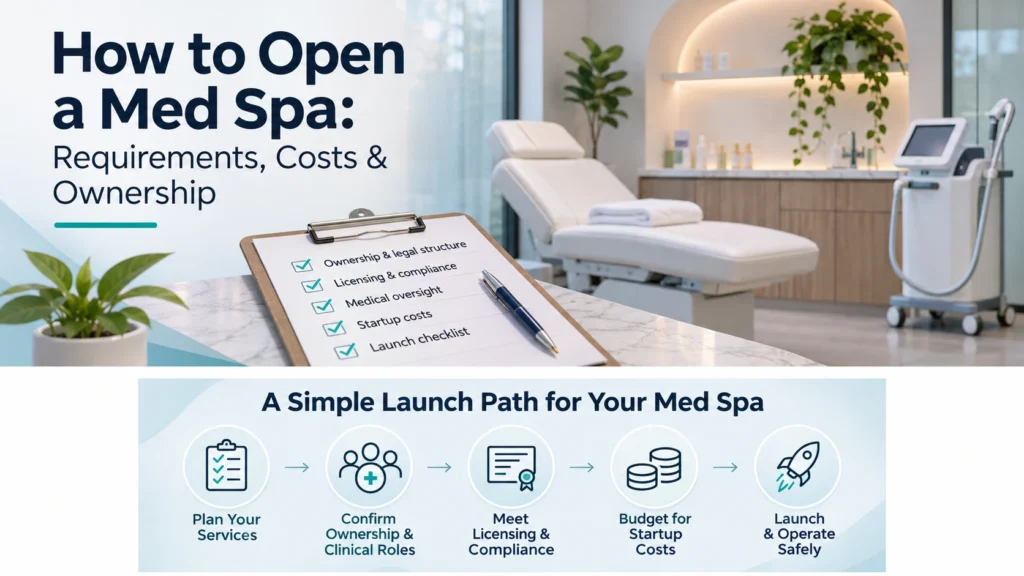
| Phase | Primary outputs | Do not advance until |
|---|---|---|
| 1. Define | State, owner, entity concept, service menu, patient, budget, revenue model | Service and ownership assumptions are reviewed |
| 2. Structure | Entity, agreements, oversight, applications, insurance, facility due diligence | The clinic can lawfully contract and build |
| 3. Build | Space, staff, technology, suppliers, protocols, evaluations, emergency system | End-to-end workflow is tested |
| 4. Validate | Licenses, permits, training, drills, chart tests, privacy, marketing review | Opening checklist is signed |
| 5. Launch and improve | Soft opening, chart review, issue log, KPI review, corrective actions | Quality controls remain active |
How to open a med spa launch checklist
Use this checklist as a project index. Every item should have an owner, due date, approval source, and stored evidence.
Strategy and business
- Choose your target state, location type, patient, service mix, and launch model.
- Complete local demand, competitor, pricing, and referral analysis.
- Build a sources-and-uses budget, cash-flow plan, break-even model, and downside scenarios.
- Define brand, positioning, website, launch campaign, and measurement plan.
Legal and regulatory
- Approve ownership, professional entity, MSO, governance, employment, billing, and fee structure.
- Form and register entities; obtain tax, business, DBA, and local approvals.
- Complete professional, facility, device, drug, lab, waste, telehealth, and other applicable applications.
- Execute leases, vendor agreements, management agreements, physician agreements, and privacy/security terms.
- Bind insurance that matches every service, provider role, location, and technology risk.
Clinical and workforce
- Appoint the required medical director, collaborating physician, supervising physician, and evaluating clinicians.
- Verify licenses, sanctions, insurance, training, scope, competence, and delegated authority.
- Approve protocols, patient-evaluation workflow, orders, consent, chart templates, follow-up, and chart-review cadence.
- Stock authorized products and emergency supplies; establish storage, inventory, recall, and waste controls.
- Train and drill emergency, exposure, privacy, downtime, transfer, and adverse-event workflows.
Facility, technology, and launch
- Obtain occupancy, fire, building, accessibility, signage, and any clinical facility approvals.
- Test the complete patient journey from marketing and booking through evaluation, treatment, payment, follow-up, and records access.
- Test user roles, secure communications, backups, downtime, vendor access, and record export.
- Run mock charts and a mock adverse event; correct gaps before the first patient.
- Schedule the first medical-direction meeting, chart review, license check, protocol review, and KPI review.
Common med spa startup mistakes
- Buying devices or signing a lease before confirming ownership, facility, scope, and delegation requirements.
- Using a medical director as a name on paper instead of documenting active clinical governance.
- Treating a generic intake form, waiver, or standing order as a substitute for a patient-specific evaluation.
- Assuming HIPAA applies to every clinic in the same way, or assuming that HIPAA is the only privacy law that matters.
- Letting vendor training or a certificate define legal scope of practice.
- Copying a state-by-state internet table without verifying current primary sources.
- Opening without service-specific emergency supplies, escalation, drills, and a post-event review process.
- Making guaranteed, unsubstantiated, or poorly disclosed health and aesthetic marketing claims.
- Launching too many services before the team can document, train, and measure them reliably.
- Failing to fund working capital for a slower ramp or unexpected licensing and buildout delays.
How GuardianMD supports med spa operators
GuardianMD helps clinics build the physician relationships and operational support needed for a med spa model that aligns with state-specific requirements. The exact service package depends on the clinic, state, ownership, provider licenses, and services.
| Need | GuardianMD support |
|---|---|
| Medical director or collaborating physician | Matching with licensed, insured physicians aligned to your clinic’s state and service model |
| Oversight setup | Agreement coordination, protocol alignment, documentation workflows, chart-review structure, and ongoing support |
| Medical clearance workflow | GuardianMD Connect telemedicine exams and record routing through qualified providers where permitted |
| Business structure support | MSO and administrative support coordinated with your clinic’s legal and professional advisors |
| Multi-state growth | Physician-network and operational coordination that can be adapted as your clinic enters new states |
GuardianMD provides administrative and technology-enabled support for your clinic. Licensed providers remain responsible for clinical care, medical decision-making, and supervision within applicable law.
Preparing to open a med spa? Talk with a GuardianMD specialist about physician matching, collaboration, clearance exams, and ongoing clinical compliance support.
The Most Trusted Name in Medical Direction
Providers choose GuardianMD for expertise, compliance, and true partnership.
Frequently asked questions about opening a med spa
Sometimes an RN can own the nonclinical business or participate through an MSO, but direct ownership of the clinical practice may be restricted. The answer depends on state ownership law, entity type, services, and who controls medical decisions. An RN license alone does not authorize diagnosis, prescribing, or independent medical practice.
An NP may be able to own a practice where state law permits it. Full practice authority does not by itself resolve entity ownership, procedure scope, delegation, or device requirements. Confirm the rules for an NP practice and the specific services proposed rather than assuming that every med spa must use a physician-owned entity.
A PA may be able to own or participate in a med spa, but entity ownership and clinical practice requirements must be checked separately. Do not assume that a physician partnership, minority stake, or MSO is required in every state. Confirm the permitted owners, PA practice arrangement, treatment scope, and prescribing authority for the proposed location.
An esthetician may own a nonmedical aesthetics business and may be able to own an MSO or participate in another permitted business structure. Whether that person can own an entity delivering medical care depends on state law. Ownership does not expand an esthetician’s authority to diagnose, prescribe, inject, or operate restricted devices.
Many med spas need physician medical direction because of their services, staff, delegation model, ownership, or state requirements. Some may require a differently named supervising or collaborating relationship. You should confirm the exact role and duties for your state and service menu.
Remote oversight may be permitted when state law allows it and your clinic meets all licensure, evaluation, delegation, availability, proximity, site-visit, documentation, and emergency requirements. Some services or states require in-person or on-site involvement.
Most clinics need entity and local business approvals plus active licenses for each regulated professional. Depending on the state and services, your clinic may also need approvals for other aspects of the business, such as telehealth services, medical waste disposal, or drug storage.
Med spa laws differ by state across ownership, medical director requirements, delegation, laser rules, and facility licensing. Check with your state medical board, nursing board, and laser or cosmetology regulator, and confirm with healthcare counsel before forming an entity in your state.
In industry usage, it is a pre-treatment medical evaluation that supports a patient-specific treatment decision. The legal standard is state and service specific, and many regulators do not use that phrase. It is different from the federal Good Faith Estimate of expected charges for uninsured or self-pay patients.
There is no reliable single price for opening a med spa. Pabau’s September 28, 2026 guide publishes a $150,000 to $500,000 planning range for lean to mid-size clinics, including a cash reserve. This is a third-party editorial estimate, not a surveyed national average, GuardianMD quote, or figure derived from GuardianMD resources or client records. Actual costs may fall outside it.
Source: Pabau med spa startup estimates
Profitability varies with service mix, product cost, staffing, rent, acquisition cost, pricing, utilization, retention, and clinical quality. Model margin by service and test conservative volume assumptions. Don’t treat gross revenue, social media visibility, or an industry average as proof of profitability.
Final word
The strongest med spa launches start with a service-by-service legal and clinical map, then connect that map to the entity, physician relationships, patient evaluation, staff, protocols, facility, technology, financial plan, and marketing. Build that system before opening, document it while operating, and recheck it whenever the law, service menu, team, or state changes. Talk with a GuardianMD specialist to learn more about setting up your med spa for appropriate clinical oversight and documentation.
Sources and further reading
State rules and agency guidance can change. Sources were checked October 20, 2026. The state examples are selective, and external startup estimates are not GuardianMD data.
- Medical Board of California
- Texas medical spa guidance
- California cosmetic treatments FAQ
- Florida Statutes §400.9905
- New York Business Corporation Law §1507
- Arizona Revised Statutes §32-1401
- EPA
- How to find a medical director
- What a medical director does in IV hydration, aesthetics, and wellness clinics
- HHS telehealth licensure guide
- CMS guidance
- Complete Good Faith Exam guide
- GuardianMD Telemedicine and Good Faith Exams
- FDA’s dermal filler guidance
- FDA warned companies about unapproved and misbranded botulinum toxin products
- Bloodborne Pathogens Standard
- HHS Covered Entities and Business Associates
- ADA guidance for businesses open to the public
- Aesthetic-device information
- Pabau med spa startup estimates
- U.S. Small Business Administration business planning resources
- FTC’s Health Products Compliance Guidance