Scaling a Wellness Franchise with Compliance Infrastructure Built In
Hydrate IV Bar grew from a single wellness spa in Denver into a 26-location, multi-state franchise by pairing strong consumer demand with scalable medical compliance infrastructure
As the brand prepared to franchise and expand across state lines, leadership recognized that varying scope-of-practice rules, Corporate Practice of Medicine (CPOM) regulations, and oversight requirements could create material risk if not addressed proactively. By implementing standardized medical oversight, telemedicine clearance workflows, and state-by-state regulatory evaluation, Hydrate IV Bar strengthened franchise consistency, improved the client experience, and positioned the model for confident, investor-ready expansion.
The Opportunity
A wellness brand built on prevention and recovery
Hydrate IV Bar was founded in 2016 by Katie Wafer Gillberg, driven by a passion for performance recovery and a belief that consumers should be able to be “the CEO” of their own health through accessible wellness services. Demand grew quickly, in part because the concept delivered a modern, lifestyle-oriented experience that felt different from traditional healthcare settings
A membership model that supports long-term retention
Hydrate’s growth was fueled by a recurring membership model—positioning IV therapy not as a one-time “quick fix,” but as part of an ongoing wellness commitment. The result was strong organic traction and durable customer relationships, key indicators for franchise scalability.

The Inflection Point
From local success to franchise-scale complexity
In the first four years, Hydrate IV Bar expanded to four corporate locations across Colorado and began preparing to franchise. But franchising changed the equation: the business wasn’t just operating locations anymore—it was preparing to support new owners, enter new states, and needed to protect the brand across markets.
The “hidden risks” that show up when healthcare franchises scale
Dr. Christopher Seitz describes two common failure points for growing healthcare franchises:
- Expanding services beyond the legal scope of practice of the clinicians they employ (RNs, NPs, PAs)
- Adding modalities that require additional compliance and regulatory infrastructure that wasn’t necessary early on
This becomes more complicated when brands expand across state lines, where ownership and care delivery rules can shift significantly.
What might be compliant in one state could be completely non-compliant in another—and that can bring significant risk to the business.
The Challenge
Growth without infrastructure creates brand and investor risk
As Hydrate IV Bar looked beyond Colorado, the team faced uncertainty that was difficult to resolve through fragmented legal advice. Katie described being bounced between attorneys and being asked, “What’s your risk tolerance?”—which didn’t work for a healthcare brand that wanted clear, defensible standards.
Why CPOM and state-by-state rules matter for franchising
Hydrate IV Bar needed to understand CPOM structures and the guidance issued by medical boards, nursing boards, and pharmacy boards in each state before entering a market.
Dr. Seitz underscores the business risk:
- What is compliant in one state may be non-compliant in another
- CPOM risk is one of the biggest risks for brands expanding across state lines
For franchise owners and investors, this impacts timelines, unit rollouts, brand consistency, and long-term valuation.
If we were not providing a safe, compliant service, we had no business.
Patient safety as a non-negotiable operating principle
Hydrate’s leadership anchored growth to a simple rule, If the care isn’t safe and compliant, the business doesn’t work.
That standard drove the search for a national partner—not just a local medical director.
The Solution
Implementing scalable medical oversight with GuardianMD
As the IV therapy industry matured and Hydrate IV Bar expanded its network, Katie was introduced to Dr. Seitz and the GuardianMD team, and the fit was immediately clear. GuardianMD was trusted, experienced, and equipped to provide the medical direction and missing infrastructure needed for nationwide expansion.
GuardianMD supported Hydrate IV Bar with a scalable oversight model designed for growth, including:
- Clinical medical directors licensed in each state
- Standardized protocols and brand standards
- State-by-state regulatory evaluation for new market entry
- Medical oversight infrastructure that scales with franchising
- Telemedicine clearance workflows to expand access to services
- Clinical support for nurses through direct provider access
Dr. Seitz describes GuardianMD’s role as partnering with franchise owners at a critical point in their growth, helping them navigate hidden risks while scaling safely and compliantly.
Operational Impact
Telemedicine clearance expanded same-day service access
Before telemedicine clearance exams, Hydrate IV Bar faced limitations serving certain populations (including minors and pregnant people) and delivering some services on demand. The previous workaround often meant sending clients back to a primary care provider for guidance or prescriptions, then asking them to return later.
With telemedicine clearance:
- Clients can complete a quick virtual visit with an appropriate provider
- Clearance and recommendations are delivered in real time
- Services that previously required a delay can often be delivered the same day
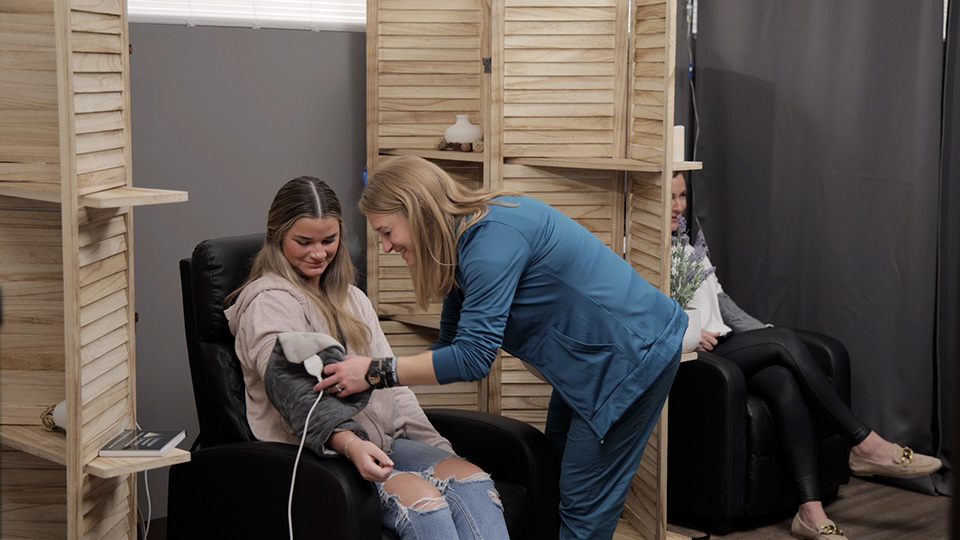
Real-time provider access increased safety and consistency in single-nurse spas
Hydrate IV Bar’s model commonly includes one nurse in the spa at a time, making escalation pathways essential. Kelsey Kinney described telemedicine and access to providers as “peace of mind” when a client’s history is complex or unfamiliar. Nurses can also use DocTalk to get clarity supporting safe practice and consistent decision-making.
Having access to another clinician gives me peace of mind when I’m servicing my clients.
Franchise development became easier to scale
Katie noted that once the right medical infrastructure was in place, Hydrate IV Bar could grow more confidently supported by people, technology, and systems that also enabled responsible menu expansion. She also emphasized the franchise advantage: new owners enter the system knowing the medical infrastructure is already handled, allowing them to focus on business execution.
Results
Investor-ready expansion built on defensible clinical standards
Today, Hydrate IV Bar is approaching its 10-year anniversary with 26 operating locations across five states and more in development. Growth is supported by systems designed for multi-state consistency helping protect clients, clinicians, franchisees, and the brand.
Why This Matters for Franchise Owners and Investors
Demand isn’t enough—healthcare franchises need infrastructure
In healthcare franchising, regulatory and clinical requirements don’t become simpler as you scale—they compound. Brands often run into trouble when they expand services beyond provider scope, add modalities without the right oversight, or underestimate how different each state can be.
Hydrate IV Bar’s path demonstrates a repeatable investor principle:
- Growth becomes scalable when compliance is systematized.
- Franchise consistency improves when clinical decisions have standards and escalation pathways.
- Valuation strengthens when risk is reduced, and market entry is predictable.