
News, Advice & Strategy for Nurse-Driven Clinics

Stay up to date on medical oversight trends, regulatory changes, physician collaboration, and how to build a successful, compliant healthcare business.

Filter posts by category

IV hydration franchise

How an IV Hydration Franchise Scaled Across Multiple States with Built-In Medical Compliance

Hydrate IV Bar grew from a single wellness spa in Denver into a multi-state franchise by pairing strong consumer demand with scalable medical compliance infrastructure. As the brand prepared to expand, leadership recognized that state-by-state regulations, scope-of-practice rules, and CPOM requirements could introduce significant risk without the right systems in place.

Founded in 2016 by Katie Wafer Gillberg, Hydrate IV Bar built momentum through a lifestyle-focused approach to IV therapy and a membership model designed to support long-term wellness. Early success created the foundation for franchising—but also introduced new operational and regulatory complexity as the company prepared to scale across state lines.
How an IV Hydration Franchise Scaled Across Multiple States with Built-In Medical Compliance Read Post »

Compliance-Ready NPs

Beyond Licensure: A Compliance Strategy for Hiring Qualified NPs Who Are Audit-Ready from Day One

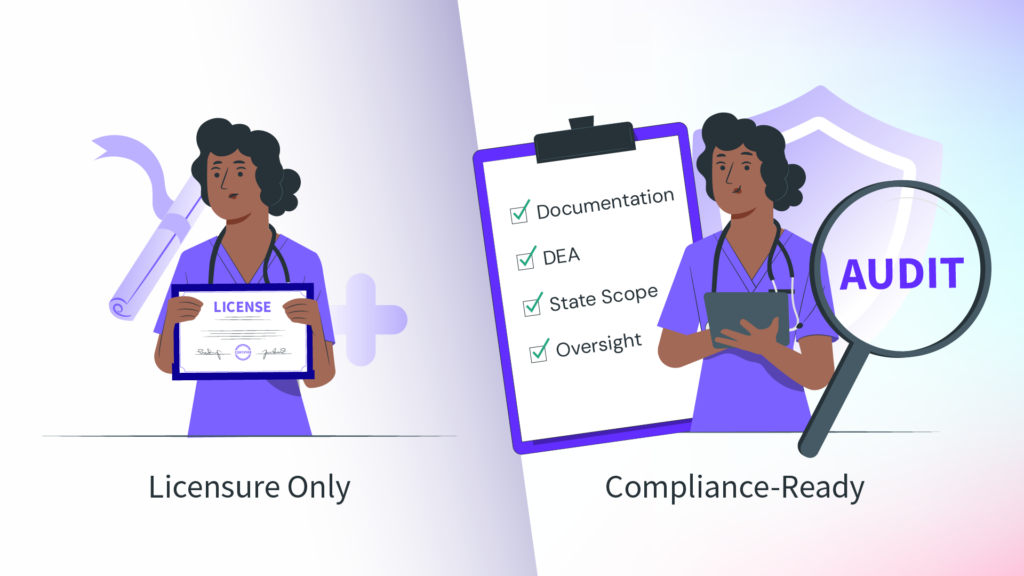
Hiring a licensed nurse practitioner is not the same as hiring a compliance ready clinician. Licensure confirms minimum eligibility, not audit readiness, documentation fluency, or understanding of state practice authority. Training quality varies widely across NP programs, and many students arrange their own clinical placements, leading to inconsistent preparation. The result is hidden risk that often surfaces during audits, chart reviews, or patient incidents. Healthcare leaders must screen for training depth, prescribing readiness, and a continued competence mindset. Compliance is not a post hire fix. It is a pipeline issue that must be built into hiring, onboarding, and oversight from day one.

Beyond Licensure: A Compliance Strategy for Hiring Qualified NPs Who Are Audit-Ready from Day One Read Post »

AIVA

AIVA Partnership Signals a New Phase for IV Therapy Compliance Nationwide

This blog post highlights the American IV Association’s announcement of an expanded partnership with GuardianMD, focused on advancing compliance, safety, and operational excellence in IV therapy. The collaboration elevates GuardianMD’s role within the AIVA ecosystem, integrating physician oversight and regulatory infrastructure more directly into member support. The post explains what the partnership means for IV therapy providers, including stronger compliance guidance, streamlined operations, and improved access to clinical resources. It also reinforces a shared mission: helping practitioners deliver high-quality care while navigating complex regulations and scaling responsibly in a rapidly evolving outpatient healthcare environment.

AIVA Partnership Signals a New Phase for IV Therapy Compliance Nationwide Read Post »

Malpractice Coverage

How Collaborating Physician Malpractice Coverage Impacts NPs

Most nurse practitioners focus on finding a collaborating physician quickly, but overlook a critical risk: malpractice coverage. Standard policies often don’t cover physician oversight roles, leaving both the NP and physician exposed during board inquiries or legal action. This article explains why traditional malpractice insurance falls short, what risks NPs face without proper coverage, and how structured enablement platforms provide protection, continuity, and defensibility. If you’re building or scaling an NP-led practice, understanding malpractice coverage in physician collaboration isn’t optional, it’s foundational to compliance, stability, and long-term growth.

How Collaborating Physician Malpractice Coverage Impacts NPs Read Post »

NP CPOM Compliance

CPOM Compliance for Telemedicine: How to Scale Virtual Care Legally 

Telemedicine may feel borderless, but CPOM laws still apply in every state where patients receive care. Regulators are increasingly scrutinizing telehealth companies to ensure physicians—not investors or MSOs—retain clinical authority. This guide explains how CPOM impacts telemedicine, the risks of improper revenue flow and strawman physician setups, and why the PC/MSO model remains the gold standard for compliant multi-state growth. Learn how telehealth startups, NP-led clinics, and investors can structure scalable, investor-ready virtual care organizations while protecting licenses and minimizing regulatory risk.

CPOM Compliance for Telemedicine: How to Scale Virtual Care Legally  Read Post »

Physician Dependency

The Compliance Gap Threatening MedSpa Platforms

Private equity–backed MedSpa platforms are scaling faster than their compliance infrastructure. While growth and consolidation have brought capital and operational efficiencies to the industry, many platforms are unknowingly exposed to structural regulatory risks that threaten continuity, valuation, and long-term viability.

This article examines the most common compliance gaps seen in PE-backed MedSpas—from fragile single-physician oversight models and multi-state supervisory conflicts to noncompliant patient-provider relationship formation and “ghost” Good Faith Exams. It explains why these failures are increasingly drawing scrutiny from regulators and how sustainable platforms are shifting from ad-hoc solutions to scalable, state-specific compliance infrastructure designed to withstand audits, physician turnover, and expansion.

The Compliance Gap Threatening MedSpa Platforms Read Post »

become a medical director

How to Become a Medical Director in 2026: Requirements, Responsibilities, and Compliance Pathways

Becoming a medical director in 2026 is more than signing charts — it’s a regulated leadership role that carries real accountability. Physicians must understand state-specific CPOM laws, delegation rules, documentation requirements, and oversight expectations to stay compliant and protect their license. This guide explains how to become a medical director step-by-step, outlines compensation models, highlights the risks of “paper” arrangements, and shows how modern compliance platforms like GuardianMD help physicians manage multi-clinic oversight safely and efficiently.

How to Become a Medical Director in 2026: Requirements, Responsibilities, and Compliance Pathways Read Post »

CPOM compliant business structure

How to Structure Your Business to Stay CPOM Compliant

CPOM compliance isn’t just legal theory—it’s how you build a durable, scalable clinic. This guide shows you how to structure a Friendly PC + MSO, draft a compliant MSA, and set a proper funds flow so all patient revenue lands in the PC before MSO fees are paid. You’ll learn why fixed or cost-plus fees backed by FMV beat risky percentage models, plus the operational layer most owners miss: clinical compliance infrastructure. From protocols and oversight to license monitoring and QA, this article gives clinic owners a clear, audit-ready roadmap to stay compliant and investor-friendly.

How to Structure Your Business to Stay CPOM Compliant Read Post »

CPOM laws and regulations in California

Corporate Practice of Medicine in California: What Every Clinic Owner Needs to Know in 2026

California has some of the nation’s toughest Corporate Practice of Medicine (CPOM) laws — meaning only physicians can own medical practices. For medspas, IV clinics, and nurse-led ventures, compliance hinges on the PC/MSO model: a physician-owned Professional Corporation (PC) for clinical care and a non-physician-owned Management Services Organization (MSO) for business operations. This article explains how to structure your entity, set compliant fee models, and avoid “strawman” risks. Whether you’re launching or scaling a clinic, understanding California CPOM is key to protecting your license and building an audit-ready, investor-friendly practice.

Corporate Practice of Medicine in California: What Every Clinic Owner Needs to Know in 2026 Read Post »

medical director aesthetics clinic

What Does a Medical Director Do in IV Hydration, Aesthetics, and Wellness Clinics?

A medical director’s role in IV hydration, aesthetics, and wellness clinics goes far beyond signing paperwork. They oversee clinical safety, ensure compliance with delegation and CPOM laws, verify licensure, establish protocols, and review charts to maintain quality care. Regulators are now cracking down on “paper” directors who fail to provide real oversight. This guide by Dr. Christopher Seitz explains what medical directors are truly responsible for—and how compliance platforms like GuardianMD help clinics and physicians manage risk, stay audit-ready, and build sustainable, compliant practices that protect patients and providers alike.

What Does a Medical Director Do in IV Hydration, Aesthetics, and Wellness Clinics? Read Post »

Good Faith Exams and Telemedicine Clearance Exams

Good Faith Exams and Telemedicine Clearance Exams: 2026 Complete Guide for Med Spas, IV Therapy and Wellness Clinics

This complete guide breaks down who can legally perform exams, the difference between state-recognized patient-provider relationships and industry buzzwords, and how to properly document telemedicine encounters to protect your license. You’ll learn the latest 2025–2026 compliance standards, discover what regulators really mean by a valid patient-provider relationship, and see why shortcut models and third-party “virtual GFE” vendors are being flagged by boards nationwide. Whether you run a brick-and-mortar clinic or a hybrid telehealth model, this article gives you a practical roadmap — from templates to risk-avoidance strategies — for keeping your operations compliant, defensible, and audit-ready.

Good Faith Exams and Telemedicine Clearance Exams: 2026 Complete Guide for Med Spas, IV Therapy and Wellness Clinics Read Post »

Scroll to Top