Key Takeaways
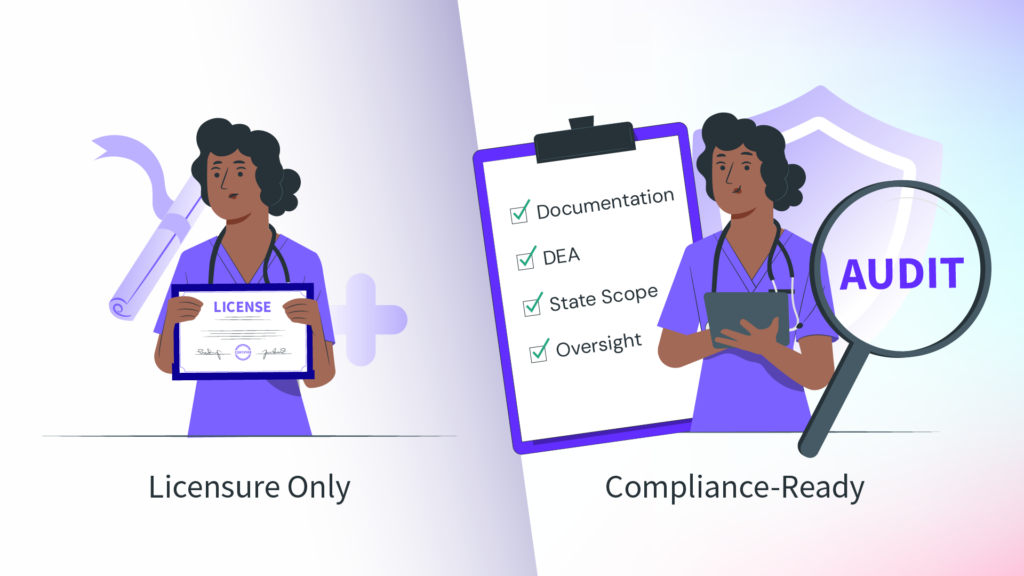
- Licensure confirms eligibility, not readiness. A license doesn’t guarantee a clinician can navigate your state’s practice authority, produce audit-ready documentation, or operate within your oversight structures.
- The training pipeline is broken. NP programs vary widely in quality, and students often secure their own preceptors, leading to inconsistent clinical exposure that credentials alone don’t reveal.
- Compliance-ready means five things. Verified training depth, documentation fluency, state practice authority knowledge, prescribing readiness, and a continued competence mindset.
- You inherit their training gaps. Your compliance infrastructure must compensate for whatever their education left unaddressed. That’s expensive and avoidable.
- Compliance is a pipeline issue, not a post-hire fix. Screen for training quality, align onboarding with regulatory requirements, and recognize that the preceptor pipeline feeds directly into hiring outcomes.
The demand for nurse practitioners has never been higher. NP-led clinics are expanding into primary and specialty care, telehealth is erasing state lines, and healthcare organizations are scaling faster than ever. On paper, this looks like progress.
Beneath the surface, it’s a compliance liability waiting to unfold.
The assumption is simple: a licensed NP is a ready NP. Board certification, state licensure, DEA registration, check the boxes, make the hire, fill the seat. This logic powers most healthcare hiring funnels today. It’s also the logic that leaves practices exposed when regulatory scrutiny intensifies.
Here’s the reality. A license confirms that a nurse practitioner met the minimum requirements to practice. It does not confirm that they understand your state’s practice authority model. It does not confirm they can produce audit-ready documentation under pressure. It does not confirm that their clinical training prepared them for the collaborative agreements, supervision protocols, or controlled substances oversight your practice demands.
The gap between licensed and compliance-ready is where risk accumulates—quietly, until an audit or incident brings it into view.
For healthcare professionals building or scaling a practice, the goal isn’t just hiring qualified NPs. It’s building a clinician pipeline that delivers regulatory compliance from day one. That means looking beyond credentials to evaluate clinical practice depth, documentation fluency, and readiness for the legal requirements specific to your state and specialty.
This isn’t about slowing down hiring. It’s about making every hire defensible, scalable, and audit-ready before they see their first patient.
Licensed vs. Compliance-Ready: The Gap Most Hiring Processes Miss
A license is a floor, not a ceiling.
State boards verify that a nurse practitioner has completed an accredited program, passed certification exams, and met minimum requirements for clinical practice. That’s the function of licensure. It confirms eligibility to practice, not readiness to perform in your specific regulatory environment.
Compliance-readiness is a different standard. It means a clinician arrives prepared for the documentation expectations, oversight structures, and clinical accountability your practice demands. It means they understand collaborative agreements in restricted-practice states, can produce audit-ready records under time pressure, and grasp the legal requirements around controlled substances prescribing in your jurisdiction.
Most hiring processes conflate these two concepts. That conflation is where liability begins.
Why the Gap Exists: The Training Pipeline Problem
The variability starts long before a candidate applies to your practice. It starts in their NP program.
Clinical training quality differs dramatically across programs. Research confirms what many in the industry already suspect, the rapid expansion of NP programs, particularly online programs, has outpaced the development of standardized clinical education. There are no uniform benchmarks for how clinical hours are structured, which settings students rotate through, or how competency is assessed. Two graduates with identical credentials can have vastly different levels of hands-on experience.
Students often secure their own preceptors. Unlike physician or PA training, where clinical rotations are institution-arranged, many NP programs require students to find their own clinical placements. This self-arranged model creates inequities. Students in well-connected programs may land robust preceptorships. Others scramble for months, sometimes settling for training environments that don’t align with their intended specialty or for preceptors too burned out to provide meaningful oversight.
Schools provide limited support. The preceptor shortage is well-documented, and competition for quality placements has intensified. Some students resort to pay-for-placement arrangements, raising ethical concerns about the commercialization of clinical education. The result: a licensed NP workforce with uneven foundations, where the credential on paper doesn’t reliably predict the clinician’s actual preparedness.
The Real-World Risk: What This Means for Your Clinical Practice
When you hire a nurse practitioner, you inherit the quality of their training or the gaps in it.
An NP with a valid license but inconsistent clinical exposure may struggle with differential diagnosis in complex cases. They may lack fluency in documentation standards that satisfy audit requirements. They may not fully understand the supervisory logic behind your state’s practice authority model or the protocols required under your collaborative agreements.
These gaps don’t surface during credential verification. They surface during chart reviews, regulatory audits, or worse, patient safety incidents.
Consider the downstream effects:
- Audit failures: If a clinician’s documentation isn’t defensible, your practice carries the exposure, even if the clinical decision was sound.
- Supervision breakdowns: In states with restricted or reduced practice authority, your collaborating physician relationships depend on NPs who understand their scope and escalation protocols. A clinician trained in a full-practice-authority state may not grasp these structures intuitively.
- Malpractice exposure: Diagnostic delays, medication errors, and scope-of-practice violations rank among the most common malpractice claims against nurse practitioners. Each of these risks correlates with training depth and documentation discipline, neither of which a license guarantees.
The hiring process that stops at credential verification is optimizing for speed, not sustainability. It fills seats. It doesn’t build a defensible, scalable clinician pipeline.
Get Matched in 7 Days or Less
Partner with a reliable physician who supports your goals. Trusted by 800+ clinicians nationwide.
The Five Components of a Compliance-Ready Clinician
To build a clinician pipeline that’s audit-ready and scalable, hiring managers must evaluate beyond the standard checklist. The following five components separate a licensed nurse practitioner from one who’s prepared to operate within your compliance infrastructure from day one.
1. Verified Clinical Training Depth
The question isn’t how many hours they logged. It’s what happened during those hours.
NP programs require clinical rotations, but the structure and quality of those rotations vary enormously. Some students train under engaged preceptors in high-volume primary care settings with direct oversight and real-time feedback. Others complete their hours in environments misaligned with their specialty focus or under preceptors too stretched to provide meaningful mentorship.
During the hiring process, go beyond:
- Ask where they completed their clinical placements and in what settings.
- Ask about their preceptor relationships, how often did they receive direct supervision? How were competencies assessed?
- Ask whether their rotations aligned with the specialty care your practice delivers.
2. Documentation Fluency
If it’s not documented, it didn’t happen. If it’s documented poorly, it’s a liability.
Audit-ready documentation is non-negotiable in any compliance-forward practice. Yet documentation standards vary widely across NP training programs. Some graduates arrive fluent in standardized templates, follow-up protocols, and the level of detail required for defensible records. Others learned documentation on the fly, in settings with inconsistent expectations.
Evaluate candidates on:
- Their familiarity with clinical documentation systems and EHR workflows.
- Their understanding of what constitutes a complete patient encounter note, history, assessment, plan, and follow-up rationale.
- Whether they were trained on documentation that satisfies both clinical and regulatory requirements.
A clinician who can’t produce compliant documentation from day one creates downstream risk for every chart they touch.
3. Understanding of State Practice Authority and NP Scope
What’s legal in one state may require supervision—or be prohibited entirely—in another.
A compliance-ready clinician understands:
- Whether they’re entering a full, reduced, or restricted practice authority state.
- What collaborative agreements or supervision structures apply to their role.
- How their NP scope intersects with state laws governing prescribing, referrals, and autonomous decision-making.
Candidates who trained or previously practiced in full-practice-authority states may not intuitively grasp the supervisory logic required in restricted environments. This isn’t a character flaw—it’s a training gap that must be assessed and addressed before they begin seeing patients.
4. Prescribing and Controlled Substances Readiness
DEA registration is the baseline. State-specific prescribing rules are the real variable.
Controlled substances prescribing is a high-risk domain with significant regulatory scrutiny. A compliant prescriber must hold active DEA registration, but that’s only the starting point. State laws layer additional requirements: prescribing limits, PDMP checks, documentation mandates, and in some cases, supervision thresholds for controlled substances that differ from general prescribing authority.
Before extending an offer, verify:
- Active DEA registration in the state where they’ll practice.
- Awareness of state-specific controlled substances rules, including documentation and audit requirements.
- Familiarity with PDMP (Prescription Drug Monitoring Program) workflows and compliance protocols.
A prescribing error or a documentation gap that looks like one can trigger board investigations, malpractice exposure, and reputational damage for the entire practice.
5. Continued Competence Mindset
Compliance isn’t a checkbox at hire. It’s an ongoing operational discipline.
Healthcare professionals who treat licensure as a terminal achievement, rather than a baseline, create long-term risk. Regulatory requirements evolve. Clinical guidelines update. State laws change. A compliance-ready clinician demonstrates a continued competence mindset: engagement with continuing education, openness to proctoring for new procedures, and willingness to participate in quality assurance processes.
Assess candidates for:
- Their approach to continuing education, do they pursue it proactively or treat it as a regulatory obligation?
- Their receptiveness to performance reviews, chart audits, and corrective feedback.
- Their understanding that privileging and credentialing are ongoing processes, not one-time events.
The clinician who resists oversight or views quality assurance as administrative burden is a liability waiting to surface. The one who embraces it is an asset you can scale with.
Where the Pipeline Breaks: Training and Oversight Disconnect
Most hiring processes treat clinical training and oversight as separate silos. Credentialing verifies past education. Onboarding establishes future supervision. The assumption is that one ends where the other begins.
That assumption is flawed.
Research confirms what hiring managers discover too late: inconsistent mentorship and lack of organizational support during training are among the most significant barriers to developing capable, leadership-ready nurse practitioners.
The oversight handoff problem: When you hire an NP, you inherit the quality of their training—or the absence of it. Your compliance infrastructure (collaborative agreements, supervision protocols, chart reviews) must compensate for whatever deficiencies their education left unaddressed. That’s expensive. It’s also avoidable.
Build Your Practice With Confidence
With over 100 five-star Google reviews, it’s easy to see why clinicians trust GuardianMD.
Building the Pipeline: Practical Steps for Healthcare Leaders
Diagnosing the problem is straightforward. Fixing it requires operational changes at multiple points in the hiring and onboarding process.
The following recommendations move beyond credential verification toward building a clinician pipeline that’s defensible, scalable, and audit-ready.
1. Refine Your Screening Process
Standard credentialing confirms licensure, certifications, and malpractice history. It doesn’t assess clinical training depth.
During interviews, ask candidates directly:
- Where did they complete their clinical placements? In what settings and specialties?
- How was their preceptor relationship structured? How often did they receive direct supervision and feedback?
- Can they provide sample documentation or case studies from their training?
2. Align Onboarding with Compliance Infrastructure
Onboarding should map directly to your regulatory requirements, not run parallel to them.
- Ensure new hires understand the collaborative agreement requirements specific to your state and practice site. Agreements are location-specific; they don’t transfer across clinics or practice entities.
- Define supervision protocols, escalation pathways, and chart review expectations before the clinician sees their first patient.
- Assign proctoring and competency assessments during the first 90 days, particularly for procedures or patient populations new to the clinician.
Treat onboarding as compliance infrastructure, not administrative orientation.
3. Invest in Continued Competence Structures
- Build continuing education tracking into your systems from day one.
- Schedule regular follow-up reviews tied to clinical outcomes, not just administrative checkboxes.
- Update collaborative agreements and clinical protocols whenever scope of practice expands. A provider working outside the scope listed in their agreement may be unprotected if a board complaint or lawsuit arises.
Documentation is tedious. It’s also what protects licenses, yours and theirs.
Conclusion: Compliance Is a Pipeline Problem
The nurse practitioners you hire today were shaped by training environments you didn’t control.
Some completed rigorous clinical rotations under engaged preceptors with structured oversight and real-time feedback. Others scrambled for months to secure placements, trained in settings misaligned with their specialty, or worked with preceptors too stretched to provide meaningful mentorship. Both hold the same license. Both pass standard credentialing. Only one is compliance-ready.
This is the structural reality most hiring processes ignore.
Building a defensible, scalable clinician workforce means accepting that credential verification is necessary but insufficient. It means screening for training depth, not just hours logged. It means aligning onboarding directly with your compliance infrastructure, collaborative agreements, supervision protocols, documentation standards, rather than treating orientation as administrative formality. It means investing in continued competence structures that tie continuing education and performance reviews to clinical outcomes, not checkboxes.
And it means recognizing that the clinical placement system feeds directly into your hiring outcomes. The preceptor pipeline isn’t someone else’s problem. It’s the upstream variable that determines whether your next hire arrives audit-ready or requires months of remediation.
Compliance isn’t a post-hire fix. It’s a pipeline issue. Build accordingly.
Whether you’re launching a new NP-led practice or scaling an existing clinic, GuardianMD provides the collaborating physician matching, medical director oversight, and ongoing compliance support you need to stay audit-ready as you grow. From pre-created protocols and collaborative agreements to chart review workflows and state-specific guidance, our team helps you build the oversight structures that protect your practice—so you can focus on patient care.
Schedule a Discovery Call to see how GuardianMD can support your compliance strategy.